
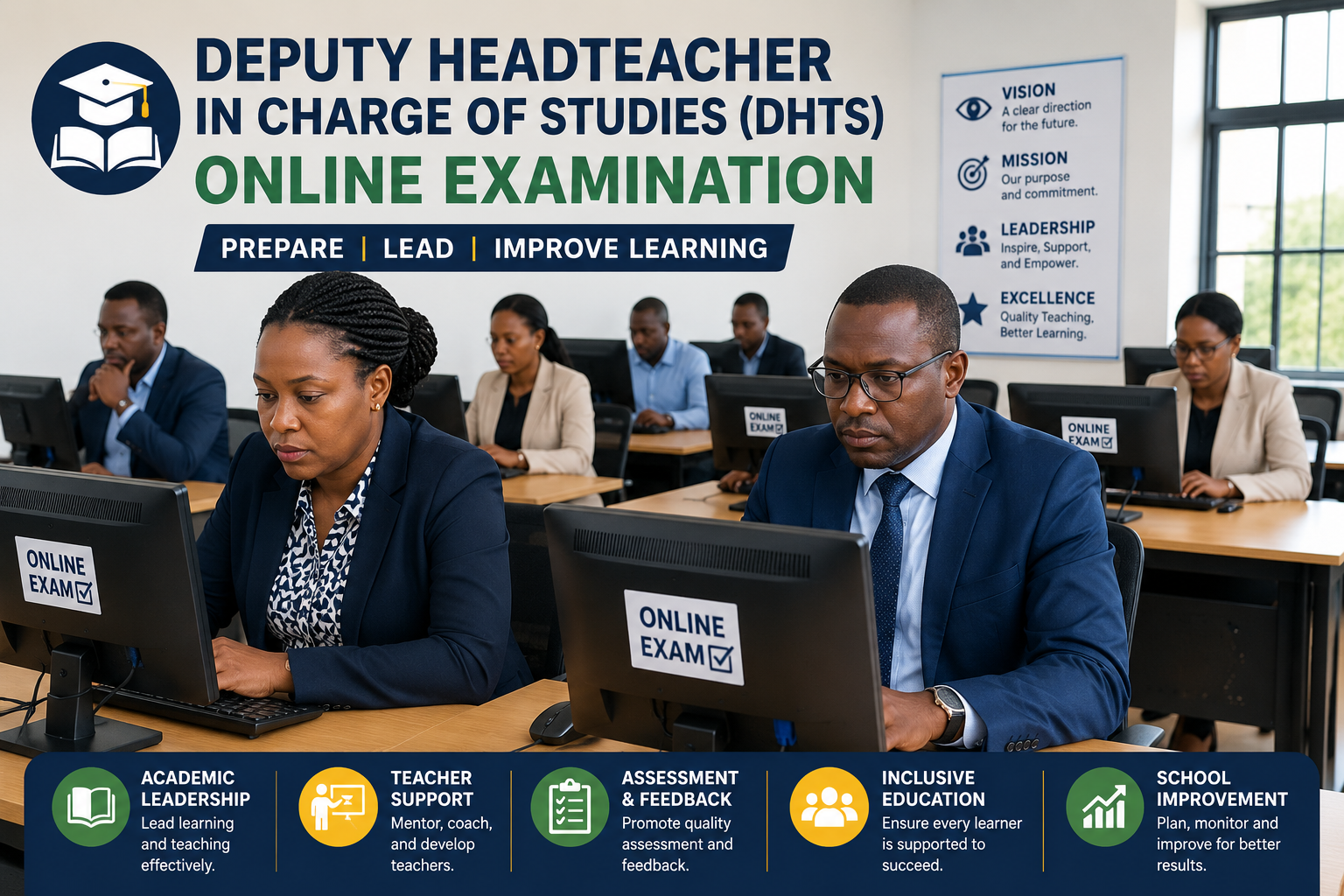
Preparing for the Deputy Headteacher in Charge of Studies Examination
The position of Deputy Headteacher in Charge of Studies requires strong leadership, academic management, and a commitment to improving teaching and learning. Candidates preparing for the examination should focus on key areas such as school vision and mission, school improvement planning, lesson observation, assessment practices, inclusive education, mentoring, and coaching.
Success in the examination requires more than memorizing concepts. Candidates should understand how educational leadership principles can be applied in real school situations. Reviewing practical scenarios and reflecting on personal leadership experiences can greatly improve performance.
Remember that the role of a Deputy Headteacher is to support teachers, improve learners’ outcomes, and contribute to the overall development of the school. Preparation, confidence, and a positive attitude are the keys to success.
The Importance of School Vision and Mission
Every successful school is guided by a clear vision and mission. A school vision describes the desired future of the institution, while the mission explains how the school will achieve that future.
Deputy Headteachers in Charge of Studies play an important role in ensuring that teachers, learners, and parents understand and support the school’s vision and mission. These statements provide direction for decision-making, teaching practices, and school improvement initiatives.
As you prepare for your examination, remember that effective educational leaders continuously communicate and promote the school’s vision and mission to create a shared sense of purpose among all stakeholders.
Effective Lesson Observation and Teacher Support
One of the key responsibilities of a Deputy Headteacher in Charge of Studies is to improve the quality of teaching through lesson observation, mentoring, and coaching. Lesson observation should not be viewed as fault-finding but as an opportunity for professional growth.
Effective lesson observation involves three stages: pre-observation conference, classroom observation, and post-observation feedback. Constructive feedback helps teachers reflect on their strengths and identify areas for improvement.
Educational leaders who support, encourage, and guide teachers contribute significantly to improved learner achievement and a positive school culture. Strong teacher support ultimately leads to better educational outcomes for all learners.