
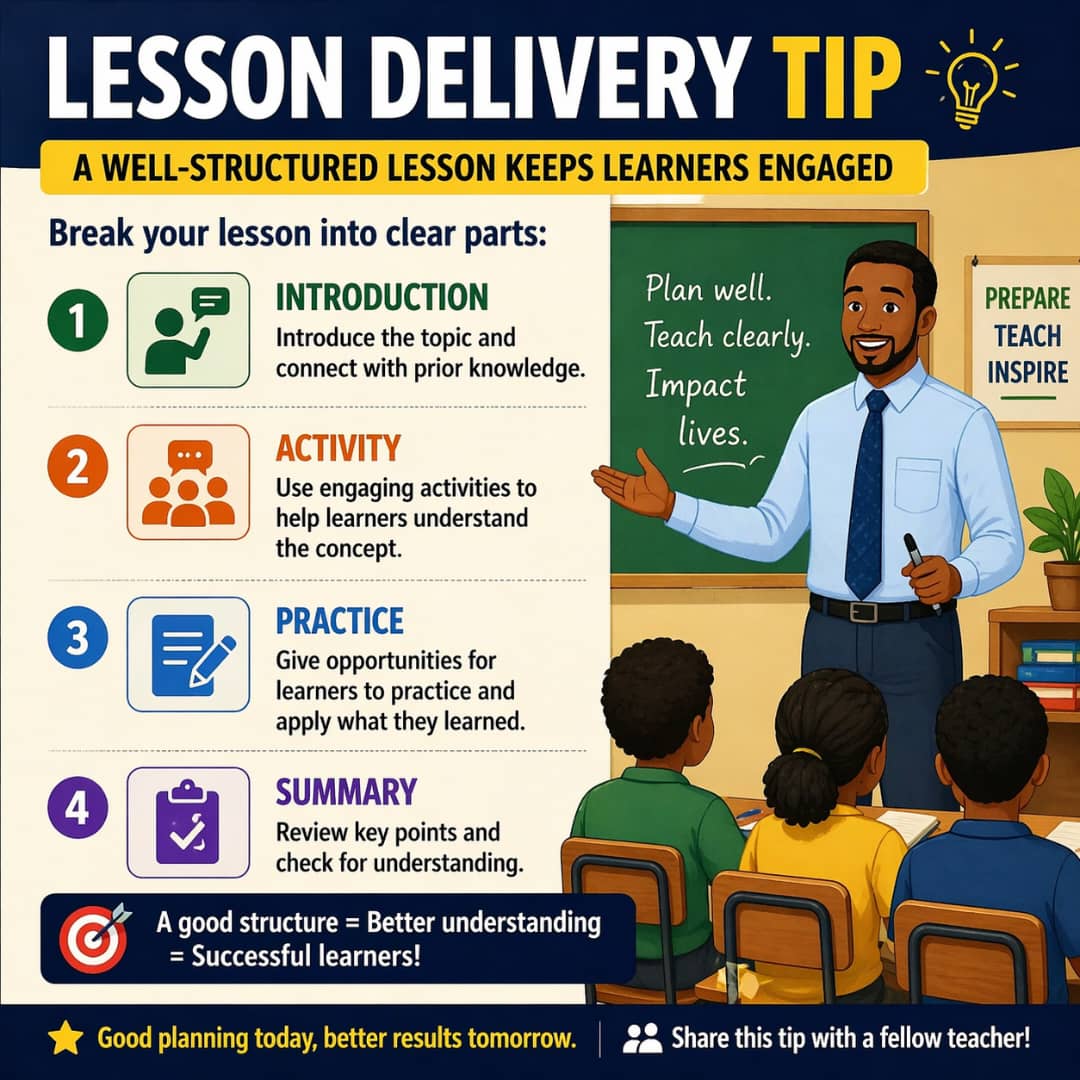
Here are practical, classroom-ready lesson delivery tips that actually improve student engagement and understanding—especially useful for teachers running active, modern classrooms:
- Start Strong (Hook the Lesson)
Don’t begin with definitions—grab attention first.
Use a quick question, story, or real-life example.
Example:
“Why do we feel hotter in Kigali when it’s humid?” → leads into a science lesson. - Set Clear Objectives
Tell learners exactly what they will achieve.
Instead of: “Today we learn fractions”
Say: “By the end of this lesson, you will compare and add fractions.” - Keep Explanations Short
Avoid long lectures. Break content into small chunks (5–10 minutes max), then engage learners. - Use the “Explain → Show → Practice” Model
Explain the concept simply
Show an example
Let students practice immediately
This prevents passive learning. - Ask Questions Frequently
Don’t wait until the end. Ask during the lesson:
“What do you think will happen next?”
“Who can explain this in their own words?”
Encourage participation, not silence. - Use Local & Familiar Examples
Relate content to students’ daily lives.
Example:
Use markets, transport, or school situations when teaching math or economics. - Move Around the Classroom
Avoid standing in one place. Walking around:
Keeps students alert
Helps you monitor understanding - Check Understanding Constantly
Use quick techniques:
Thumbs up/down
Quick quizzes
Pair discussions
Don’t assume they understand—verify it. - Encourage Student Talk (Not Just Teacher Talk)
Let learners:
Discuss in pairs
Present answers
Teach each other
The more they talk, the more they learn. - Manage Time Wisely
Plan your lesson like this:
5 min → Introduction
15 min → Teaching
15 min → Practice
5 min → Review - Use Simple Teaching Aids
Even without technology:
Draw diagrams
Use real objects
Write clearly on the board - End with a Strong Summary
Don’t just say “time’s up.”
Ask:
“What did we learn today?”
“Who can summarize?” - Give Quick Feedback
Correct mistakes immediately and positively:
“Good try—check this part again.” - Be Energetic and Positive
Your energy affects the class.
If you’re dull, the lesson becomes dull. - Reflect After the Lesson
Ask yourself:
What worked?
What didn’t?
What will I improve next time?